Featured papers
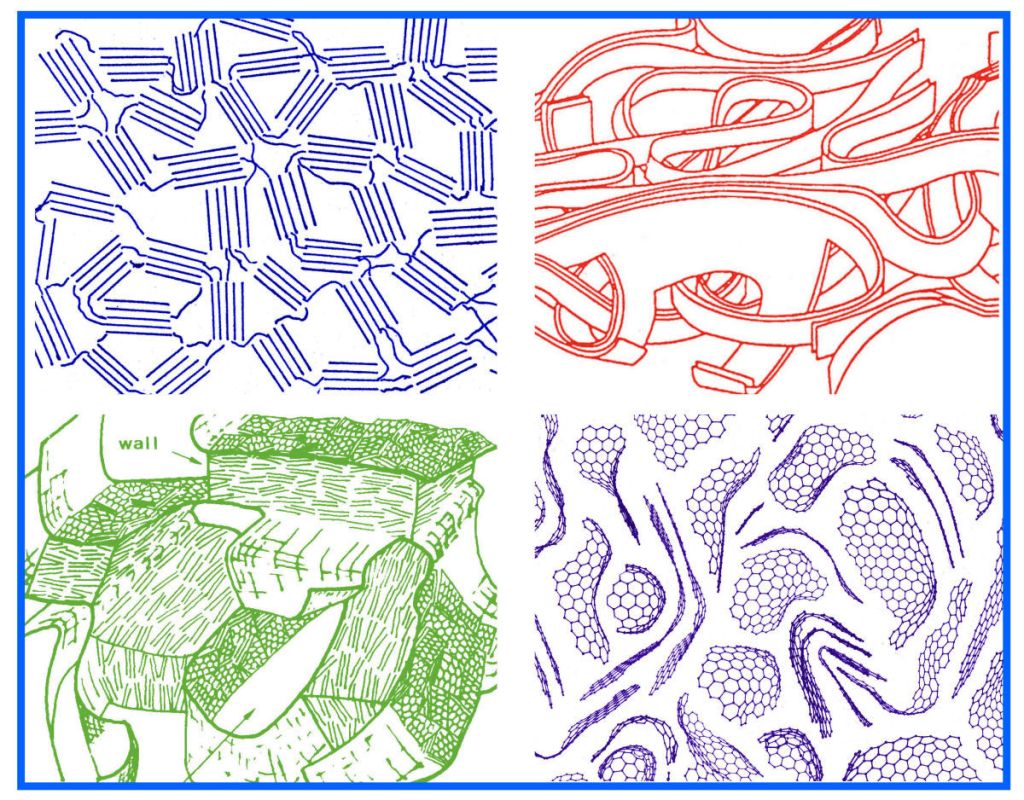
Structural models of non-graphitising carbon: a brief history, P J F Harris, C, 11, 78 (2025).
This article is a contribution to the 10th anniversary edition of the open-access journal C — Journal of Carbon Research. It reviews theoretical models for the structure of non-graphitising carbons (i.e. chars), from the classic work of Rosalind Franklin in the early 1950s, to the latest thinking on the subject, which is based on the idea that the structure contains non-hexagonal rings, as in the fullerenes and fullerene-related structures. Studies using aberration-corrected transmission electron microscopy provide important support for this idea (see below).

Aberration-corrected transmission electron microscopy of a non-graphitizing carbon, C S Allen, F Ghamouss, O Boujibar and P J F Harris, Proc Roy Soc A, 578 20210580 (2022).
This is a study of the atomic structure of an activated carbon using aberration-corrected transmission electron microscopy. The images showed clear evidence for the presence of pentagonal and heptagonal carbon rings. This provides support for a model of the structure of this kind of carbon which was put forward by myself and S C Tsang in 1997. In this model the structure is made up of curved fragments in which non-hexagonal rings are dispersed randomly throughout hexagonal networks. The carbons, which were prepared by Fouad Ghamouss and Ouassim Boujibar of the University of Tours, France, had exceptionally high surface areas and open structures, making them ideal for imaging. The electron microscopy was carried out at the Electron Physical Science Imaging Centre at the Diamond Light Source in the UK by Chris Allen. A schematic drawing of the proposed structure of the carbon appeared on the cover of the journal.

Rosalind Franklin, carbon scientist, P J F Harris and I Suarez-Martinez, Carbon 171 289 (2021).
In this paper, Irene Suarez-Martinez of Curtin University, Australia, and I aimed to draw attention to Rosalind Franklin’s outstanding carbon research, which she carried before her far more famous work on DNA and viruses. The point of the paper was to commemorate the 100th anniversary of Franklin’s birth in 2020. For reasons best known to themselves, the journal decided to publish it in the first issue of 2021.

Microscopy and literature, P J F Harris Endeavour 43 100695 (2019).
In this article I talk about literary works which have been influenced by microscopy, or in which microscopy has played a significant role. There are more of these than you might think. The work of writers including Jonathan Swift, Voltaire, George Eliot, H. G. Wells and D. H. Lawrence is discussed.
Transmission Electron Microscopy of Carbon: A Brief History, P J F Harris C 4 4 (2018).
This review, published in the open-access journal “C” describes the ways in which TEM has been used in the study of solid carbon since the 1940s.
Books

“Elemental Carbon”
Edited by Peter J F Harris, Royal Society of Chemistry, 2024.
This book covers some of the most rapidly developing areas of contemporary carbon science, including both well-established materials such as graphite and carbon black and new forms such as graphene. As well as giving a brief history of each topic, the five chapters provide reviews of the latest research, covering synthesis, chemical and physical properties, and applications.
Contents
Chapter 1: Graphite and Carbon Fibres
By Dong Liu; Ming Jiang; Kevin D. Potter; Peter J. F. Harris
Chapter 2: Synthesis, Properties and Applications of Graphene and Related Materials
By Nicholas Yung Li Loh; Wan Ting Tee; Billie Yan Zhang Hiew; Svenja Hanson; Suyin Gan; Lai Yee Lee
Chapter 3: Carbon Black: Manufacturing Processes and Fundamental Properties
By Charles R. Herd; Lewis B Tunnicliffe
Chapter 4: Carbon Dots
By Khurram Abbas; Lei Jiang; Yuan Li; Zijian Li; Hong Bi
Chapter 5: Low Pressure Synthesis of Diamond by Chemical Vapour Deposition and Its Technological Applications
By Neil A. Fox
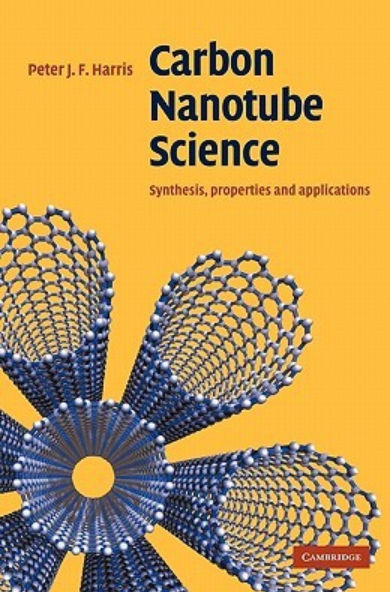
Carbon Nanotube Science
Synthesis, Properties and Applications
Cambridge University Press, 2009.
ISBN-10 0521005337
Essentially an updated version of book I wrote in 1999 (see below), but solely covering carbon nanotubes
Review by Dirk Guldi, Chemistry World: ‘You will hardly find a more comprehensive reference on the science of carbon nanotubes. Written by Peter Harris, 12 individual chapters incorporate the most recent technological advances and research developments on an exceptionally timely topic. This new book is an appropriate addition to its predecessor Carbon Nanotubes and Related Structures…. Personally, I would recommend this book to chemical physicists and physical chemists, and to those broadly interested in nanoscience.’

Carbon Nanotubes and Related Structures
New Materials for the Twenty-first Century
Cambridge University Press, 1999
ISBN-10 0521828953
The first single-author book on carbon nanotubes. As well as nanotubes themselves, it covered curved crystals, inorganic fullerenes and nanorods.
Some more of my peer-reviewed papers
- Structural Models of Non-Graphitising Carbon: A Brief History, P J F Harris, C, 11, 78 (2025).
- Catalysis-free transformation of non-graphitising carbons into highly crystalline graphite, J L Fogg, K J Putman, T Zhang, Y Lei, M Terrones, P J F Harris, N A Marks & I Suarez-Martinez, Communications Materials 1, 47 (2020).
- The closed-edge structure of graphite and the effect of electrostatic charging, V Posligua, J Bustamante, C H Zambrano, P J F Harris & R Grau-Crespo, RSC Advances 10, 7994 (2020).
- Structures formed by passage of current through graphite: flat or three-dimensional?, P J F Harris Carbon 156 416 (2020).
- Structural transformation of graphite by passage of electric current, P J F Harris Fullerenes Nanotubes and Carbon Nanostructures, 28, 66 (2020).
- Non-graphitizing carbon: its structure and formation from organic precursors, P J F Harris Eurasian Chemico-Technological Journal 21 227 (2019).
- Pulsed thermal treatment of carbon up to 3000 degrees C using an atomic absorption spectrometer, K.J.Putman, M.V.Sofianos, M.R.Rowles, P.J.F.Harris, C.E.Buckley, N.A.Marks and I.Suarez-Martinez, Carbon, 135,157 (2018).
- Engineering carbon materials with electricity, P J F Harris Carbon 122 504 (2017).
- The structure of junctions between carbon nanotubes and graphene shells, P J F Harris, I Suarez-Martinez and N A Marks Nanoscale 8 18849 (2016).
- Fullerene-like models for microporous carbon, P J F Harris, Journal of Materials Science, 48 565 (2013).
- Structural transformation of graphite by arc-discharge, Phil. Mag., 91, 2355 (2011).
- Open and closed edges of graphene layers, Z Liu, K Suenaga, P J F Harris and S Iijima, Phys. Rev. Lett., 102, 015501 (2009).
- Ultrathin graphitic structures and carbon nanotubes in a purified synthetic graphite, J. Phys -Cond. Mat, 21, 355009 (2009).
- Imaging the atomic structure of activated carbon, P J F Harris, Z Liu and K Suenaga, J. Phys. – Cond Mat., 20, 362201 (2008).
- How realistic is the pore size distribution calculated from adsorption isotherms if activated carbon is composed of fullerene-like fragments?, A. P. Terzyk, S. Furmaniak, P. J. F. Harris, P. A. Gauden, J. Wloch, P. Kowalczyk and G. Rychlicki, Phys. Chem. Chem. Phys., 9, 5919 (2007).
- New perspectives on the structure of graphitic carbons, P J F Harris, Critical Reviews in Solid State and Materials Sciences, 30, 235 (2005).
- Fullerene-related structure of commercial glassy carbons, P J F Harris, Phil Mag 84, 3159 (2004).
- High-resolution transmission electron microscopy of carbon and nanocrystals in the Allende meteorite, P J F Harris and R D Vis, Proc Roy Soc A, 459 2069 (2003).
- Rosalind Franklin’s work on coal, carbon, and graphite, P J F Harris Interdisciplinary Science Reviews 26 204 (2001).
- Carbonaceous contaminants on support films for transmission electron microscopy, P J F Harris, Carbon, 39, 909 (2001).
- On Charcoal, P J F Harris Interdisciplinary Science Reviews 24 301 (1999).
- Structure of non-graphitising carbons, P J F Harris, International Materials Reviews, 42, 206 (1997).
- High-resolution electron microscopy studies of non-graphitizing carbons, P J F Harris and S C Tsang, Phil Mag A, 76, 667 (1997).
- A simple chemical method of opening and filling carbon nanotubes, S C Tsang, Y K Chen, P J F Harris and M L H Green, Nature, 372, 159 (1994).
- Direct imaging of an adsorbed layer by high-resolution electron-microscopy, D A Jefferson and P J F Harris, Nature, 332, 617 (1988).
- Sulphur-induced faceting of platinum catalyst particles, P J F Harris, Nature, 323, 792 (1986).
 Peter JF Harris